.png)


Racing Series Episode 1: Jimmie Johnson, by Parker P.

Jimmie Johnson: An American Racing Legend
The day is October 7th, 2001, where a young racer in search of his first big break in NASCAR, would race for Hendrick Motorsports, one of the most successful racing teams in the United States. Champion of the season, Jeff Gordon, would play a crucial role in the young hotshot signing with the team. The young hotshot would finish 39th, after a crash late in the running, but this would not be the end of the 26-year-old from California, Jimmie Johnson.

First Wins
Jimmie Johnson would make his return the following year, now with a full-time ride in the #48 car. He would kick things off by winning the pole for the 2002 Daytona 500, but would end up finishing in 15th. A solid showing for the California-native. This was a decent run, but to see his first big break, we’d have to skip a bit ahead. April 28, 2002, the day of the NAPA Auto Parts 500. This race would take place in Jimmie’s home state, California, at Auto Club Speedway. Johnson, after leading 62 of 250 laps, would take the trophy and win his first NASCAR Cup Series race.
Their First Crown
Whether the sport knew it at the time or not, they had just found their new champion. In the span of ‘03 to ‘05, Johnson would pick up 15 wins. The #48 just couldn’t be stopped, and by the start of the 2006 series, that would be realized and then some. The Daytona 500, one of the sport’s and world’s biggest motorsports events, would be won by who else but Jimmie Johnson. This kicked off a strong note to the 2006 season, but he wasn’t done there.

The Brickyard 500, which first made its debut in 1994, would take place at the Indianapolis Motor Speedway. For that reason, it is also considered a big deal to win. Of course, Johnson would win here too, picking up his 3rd of 5 wins in the season. For how dominant this team was in the mid-2000’s, they still had yet to win a championship, but with all the momentum on their side, many people expected this year to be the year. Heading into the chase, a points reset with 10 races to go, Johnson and his team didn’t have the best start, finishing 39th in the first chase race at New Hampshire. Things would moderately improve the next race at Dover, but it seemed the #48 team choked entering the post-season. At Talladega, the biggest track on the schedule, it seemed like Johnson had a fair shot to win, pulling a last lap move on driver and future teammate Dale Earnhardt Jr.. But coming to the third turn, Johnson’s teammate, Brian Vickers, eager to get his first win, would make a controversial move to make that happen, hooking both Johnson and Earnhardt.

Despite the setback, Johnson would score a much needed runner-up at Charlotte, and even score a win in the race after that in Martinsville. He would continue to score good finishes in the remaining races, even scoring back-to-back-to-back runner-ups the next three races, making up for the rough start in the post-season. Finally, at the last race at Homestead-Miami Speedway, Jimmie Johnson, finishing 9th, would take home his first NASCAR Cup Series Championship. As we now come to know, his first of many.

The Dynasty
Little did we know it at the time, this would kick off one of the most dominant NASCAR dynasties in history, besting drivers like Carl Edwards, Kevin Harvick, Kyle Busch, and teammate Jeff Gordon, to win 5 consecutive championships from 2006 to 2010. In all of those seasons, he has proven to be the class of the field, while not being the best in the whole season, but being the best when the lights were at its brightest. In 2011, fewer wins would come out of it, failing to keep up with contenders Carl Edwards and Tony Stewart. But one of those wins would prove to be a memorable one. This took place during the tandem-drafting era on the big tracks such as Daytona and Talladega, where two cars (which don't have to be teammates) link up and create an extremely fast force. The only problem, if you push someone the wrong way, you’ll send them spinning, so you have to be very cautious when performing this. In the 2011 Aaron’s 499, this strategy worked like a charm, and created one of the most iconic finishes in NASCAR history. Jimmie Johnson, being pushed by teammate, Dale Earnhardt Jr. They were 3x3 coming to the finish line, with Johnson getting the best of teammate Jeff Gordon, and other Chevy driver Clint Bowyer.
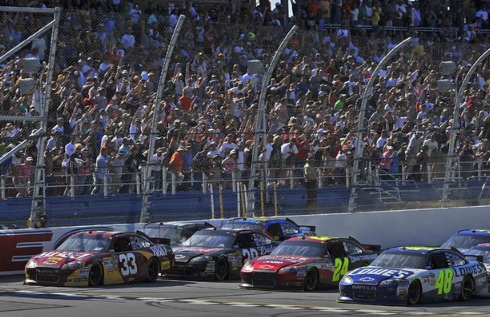
Back to the main show, his 2011 season was one to forget, and his team was searching for redemption come 2012. And redemption they’d get–almost. Although they had another great season they fell short of a 28 year old, having his first generational run, Brad Keselowski. The end of this season would mark a new generation of the NASCAR car. Debuting in 2013, the generation 6 car would take over the track, and Johnson’s #48 team was looking for improvements in this new car. And improve they would, kicking off the season by winning their second Daytona 500.

This would prove, like 2006, that winning the season opener meant winning the championship. And like that, Johnson and crew chief Chad Knaus would have six championships, one away from a landmark seventh. If you don’t know, seven has been the record number of championships for a while, being set by Richard Petty, and matched by Dale Earnhardt. This was the goal the Lowes team was going for.
Journey to Seven
In 2014 and 2015, he would win his fair share of races, but wouldn’t be close to a title contender–including a disappointing first round elimination in 2015 in NASCAR’s playoff system. This was alarming at first, but Johnson would just need another year to pick back up where he left off in 2013. Winning an early race at Atlanta would secure his bags to the playoffs, followed by another trip to victory lane in California. He was winning, but consistency was not the #48 team’s best strength this year, finishing 8th in the regular season before the playoffs started, nowhere near a contender. But as he’s shown in the past, it’s hard to doubt Jimmie Johnson. He enters the playoffs seeded in 5th, because of his amount of wins. The first couple races of the playoffs were fairly ho-hum for this team, picking up decent finishes, but they would need to improve. They would do that in the next round of the playoffs, picking up a win in Charlotte, securing his spot in the next round. This was it, his chance to pick up a landmark seventh championship. Johnson, of course, would win at Martinsville, the first driver to lock himself into the Championship. Other drivers would win their way in too, including Carl Edwards, who won at Texas, Joey Logano, who won at Phoenix, and Kyle Busch, who barely made it in on points alone. The stage was set for another battle.

Seven
Just like that, sixteen became four, and the championship race in Homestead, Miami was underway. Undoubtedly the fastest car of the four was Carl Edwards, leading the third most laps and most of the Championship Four. The one who was up front the least was Jimmie Johnson, being a top 10 car, but not a championship contender. This would change as the race progressed, Jimmie would come up closer to the front, but even then, it was all Edwards–until a backmarker driver blew an engine, forcing a caution, forcing a restart. This would mean all 3 other championship contenders would have a closer shot at catching Edwards, and lined up right behind him, Joey Logano. Logano had to make a move, so he did, but Carl blocked, resulting in Edwards wrecking, and now, his hopes went up in flames. This left the door wide open for two other contenders–Joey Logano and Jimmie Johnson, and only the latter succeeded. Jimmie Johnson, after taking control of the restart, would cruise home for his seventh championship.


Comments