.png)


Best Pottery Wheels, by Robby C.

Did you know that you can make your own cups and dinnerware at home? There are many pottery wheels for sale, but not all of them are the best. This overview of pottery wheels will discuss the myriad of pottery wheels available for sale, and will tell you the best wheel, if you ever want to start pottery.
Pottery is the art of making usable and decorative items from clay. According to Britannica, people have been making pottery as early as 3000 BCE. Being a potter was a job in both Ancient Egypt and Ancient Mesopotamia. Potters would use the pottery wheel, or the potter’s wheel, to make the tableware and storage jars needed for survival. They were an essential part of early civilizations. Pottery was essential for trade, and impacted a civilization’s overall economic performance. Pottery used to be done mainly by hand, and on a potter’s wheel, so even if 2 different pieces of pottery looked the same, they would all be unique, and they would be handmade. But now, most of the cups, bowls, and plates we use today are mass produced in a factory by slip casting into molds, making them practically identical to each other and not unique. Traditionally, both men and women played an essential role in making pottery.
To make pottery, you will usually need a pottery wheel. Pottery wheels used to be foot powered kickwheels, where you spin the wheel head by kicking it, but now, there are much more advanced and stronger electric wheels for sale. AMACO, which is a brand that manufactures high quality pottery wheels, has a wheel called the Model C. According to AMACO, the "Model C is recommended for both schools and art centers, is competitively priced, is quiet and solid, and can handle 225 pounds of clay continuously.” (“Brent Wheels”) To start throwing, which is the term used for making pots on the pottery wheel, you will need multiple items. You will of course need the pottery wheel, then you will need a bucket of water to dip your hands in. You will also need a wooden rib, a pottery sponge, a wire tool, and if you want, a stainless steel rib. Pottery will seem hard at first, but after you get the muscle memory, which takes quite some time, you will be making cups like it was second nature, and you would be able to mass produce them, all with your own hands! They will look almost identical, but each of them are still different, since they were made by a real human taking time to make them, not some company making thousands a day. Potter pieces can be so small that it fits on your finger, or larger than a full grown human! Pottery has to be dried before it is fired, or heated up in a kiln, and the whole process of making one cup or bowl will take about a week, if not longer. Making more pottery per session will be better because they will dry together, which means that you won’t have to wait longer. Also, in order to make usable pottery, you will have to fire it twice, and each firing takes about 24 hours total, from the second the kiln starts heating up to when the kiln has cooled enough to be able to be unloaded. Smaller pieces will take much less time than larger pieces, which can even take up to a few months to be completely finished. Larger pieces also require much more care, since they are more prone to cracking or breaking while drying or firing in a kiln.
Which pottery wheel is the best, and why?
When you choose your pottery wheel, there are many things you have to take into consideration. First, you have to think about what type of pottery you will be making. For example, will you be a production potter, making dozens of cups a day, or just a hobbyist making pottery once in a while. You also have to know if you want a direct drive wheel or a belt driven wheel. A direct drive wheel has its motor mounted directly under the wheel head, which is where you will be making the pot. The motor in this type of pottery wheel is connected to the wheel head, eliminating the need for gears and belts. Some advantages of this wheel are that it responds immediately when you step on the foot pedal, and when you top the wheel, the wheel head stops immediately. It is also more durable, since it doesn’t have a belt that can break. On the other hand, a belt driven wheel has a belt connecting the wheel head to the motor, which makes it more prone to breaking, since the belt does get worn out after continuous use. I prefer belt driven wheels, since they are usually more powerful and can handle more clay than direct drive wheels. Also, they are not as bulky as direct drive wheels, which has a large box under the wheel head that houses the motor. Now, let's get to the actual pottery wheels.
Vevor 450W pottery wheel

Priced at around 150 dollars USD, this wheel is the most affordable wheel on this list, and is the wheel I own. It has several advantages, along with a few major disadvantages. The first advantage is that it has plenty of power for such a small wheel. It can hold up to 17 pounds, which is usually enough for hobbyists who make small pieces, but has too little power for production potters making many pieces daily. Also, its wheel head is 11 inches in diameter, which is large enough for most hobbyist potters. It has a touch screen on the side that controls the speed of the wheel head, which can be controlled by the foot pedal or 2 buttons that speed up and slow down the wheel. The wheel is also good for left handed potters, since the wheel head can rotate clockwise and counterclockwise. The touchscreen has a display that tells you how many RPMs (revolutions per minute) the wheel head is spinning, and it doesn’t lag behind. Overall, the touchscreen is good, but it is not directly a part of the wheel, but an insert, so its water resistance level is questionable. The plug for this pottery wheel is a normal plug and will plug into the standard 120 volt outlets found in many homes. Now, let’s take a look at the disadvantages. First, the foot pedal, which is that part that controls the speed of the wheel, is connected to the wheel itself and not adjustable, which can make throwing uncomfortable. The area of the foot pedal is also too small, and I can not even put my whole foot on it. Luckily, there is a hand powered lever that also controls the speed, and if that doesn’t work, there is the touchscreen. Second of all, the speed is a severe inconvenience. The more heavy-duty and professional wheels can go from 0-240 RPM, and this wheel can go from 60-310 RPM, or at least that’s what the display says. I’ve gotten it up to 320 RPM, but that’s way too fast. You can probably already see the problem. The wheels can go at 10, 20, 30, 45, and 50 RPM, but the Vevor wheel’s slowest wheel speed is 60 RPM. This might seem slow, but it is actually way too fast for many pottery operations, especially if you are a beginner. The recommended speed that I use is around 50 RPM for most of my pottery operations, but the wheel goes way too fast for that. This can result in the pot twisting, since your hands are not moving fast enough for the wheel. When I am trimming, I usually go at around 30 RPM, which is my ideal speed, but I can’t do that on this wheel, which makes trimming really hard and risky for your pot. Overall, this wheel is a good choice for hobbyists, but has several major disadvantages, making it not as suitable for some people, especially beginners. This wheel weighs around 30 pounds. It is one of the best, affordable, and powerful pottery wheels on the market. It will surely jump-start your pottery experience.
Shimpo VL-LITE

Now, we’re going to get to the professional pottery wheels. This wheel is very popular with many art studios, private and public. It is a little pricier than the Vevor wheel, at 1,250 dollars USD. It can hold up to 25 pounds of clay, which is much less than the heavy duty wheels, which can hold up to 400 pounds. Just like the Vevor wheel, it has some advantages, along with some disadvantages. The first advantage is that just like its name suggests, it is lighter than most of the heavy duty wheels, at 51 pounds. It has a heavy duty, all metal foot pedal that connects to the pottery wheel by a cable, which means that you can move it around and adjust it to be comfortable for your foot. The foot pedal is also shaped like a wire triangle, and is large enough to accommodate your foot, with some space left over. The wheel head is 12 inches in diameter. The splash guard, which is at the side of the wheel, is circular and easily removable. It is also very durable, and made with relatively thick plastic. This Shimpo VL LITE is blue and white, making it very easy to spot areas that you have to clean. The switch is not a touchscreen, but instead is a heavy duty flip switch. This makes the wheel much more durable. The wheel is also very sturdy for its weight. The wheel’s components (the motor, wires, and control box) are all housed in plastic, unlike the Vevor wheel, which has a metal housing. This wheel is also much taller than the Vevor, making it easier to throw on without putting it up on supports. Some of the disadvantages include that the wheel is light, but it is also very bulky. Finally, the reason that I don’t really like this wheel is because after some use, the foot pedal will become very stiff and hard to press down on, so then you have to loosen the screws on the foot pedal. Overall, this wheel is one of the most popular choices for potters looking for a cheaper and durable wheel. It is not as powerful as the other wheels, but is a solid choice for potters who want to spend a little more money on their equipment. This wheel runs on a 120 volt outlet, but you will need a dedicated circuit, otherwise the wheel could overload the breaker. This wheel goes from 0-250 RPM smoothly. This wheel is belt driven.
Speedball Clay Boss

This wheel is one of my favorites. With a 0.5 horsepower industrial motor and a 100 pound clay capacity, it is strong enough to handle most pottery tasks. My favorite part of this wheel is the food pedal. It is very comfortable and very smooth. The foot pedal is not too easy to push down on but not too hard, making it perfect for precise speeds. The wheel head is also very large, and is not silver colored like the other wheels, but is instead steel with a polypropylene composite surface on top to prevent rust and to make it lighter and more durable. The other wheels typically have an aluminum wheel head. The splash guards, which are also brown, are very easy to remove and even easier to clean. That is one of my favorite features of this wheel. In fact, this wheel is probably the easiest to clean out of all the wheels on this list. The wheel is usually very smooth, but after a lot of use, the wheel’s controller can glitch and it can lag behind the movements of the foot pedal. Many times, I would press on the foot pedal to make the wheel head stop spinning, and it would keep on spinning, and the only way you could turn it off was if you turned off the power switch. Another disadvantage of this wheel is that it is very hard to make this wheel go clockwise, so it might be hard to throw on for left handed potters. The price tag for this wheel is not much higher than the Shimpo, at 1400 dollars USD. This wheel can usually plug in and work on a standard 120 volt outlet, and is belt driven.
AMACO Brent B, C, and CXC
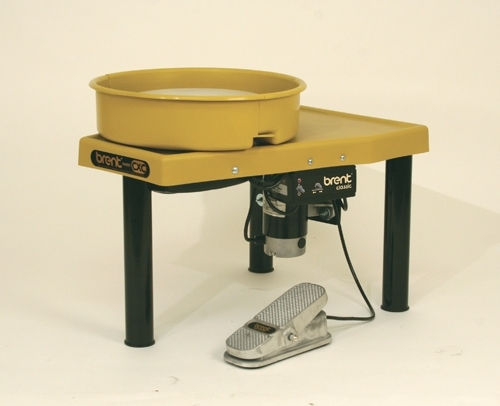
These three wheels, the Model B, Model C, and Model CXC, are all made by AMACO. They are basically the same, except for the amount of clay that they can handle. The Model B, which is the wheel I usually use, can handle up to 150 pounds of clay, the Model C can handle up to 225 pounds of clay, and the Model CXC can hold up to 300 pounds of clay. They are all generally the same, but the main wheel I will be talking about is the Brent B. The Brent B is my favorite wheel in this list. I think it performs way better than the Vevor, the Shimpo, or the Speedball. As I previously stated, the Brent B can hold up to 150 pounds of clay, which is a lot, even for most professional potters. The foot pedal is not as wide, but is still large enough. It is textured for better grip, and is made out of steel. This pottery wheel has a standard flip switch controller, and is very easy to switch the spin direction from clockwise to counterclockwise. The wheel is very stable, and even comes with a free plastic bat (attachable throwing surface) for throwing on. It is the most expensive wheel here, costing 2,600 dollars USD. It remains very stable during use. One disadvantage of this wheel is that its splash guard is the hardest to remove and clean. This might affect how much time you have before you have to start cleaning up. The motor is strong, but is also louder than some of the other wheels, especially if you don’t maintain it. Overall, this wheel is my favorite and my top pick. It comes with many advantages, but also has a few disadvantages. It operates very smoothly under a lot of force, and maintains power all the way. It can plug into a 120 volt outlet. If you are starting pottery, this wheel is probably your best long time friend in pottery.
The pottery wheels stated here are all very good, but each of them has its own pros and cons. Overall, in my own personal experience, the Vevor wins the award for the most affordable wheel, the Speedball wins the award for the wheel that’s the easiest to clean, the Shimpo wins the award for being the cheapest heavy duty wheel, and the Brent B wins the best overall wheel.
There are many pottery wheels on the market, but not all of them are the best. There are a countless number of pottery wheels for sale, but not all of them are the best. Pottery is a very old art form, but the electric pottery wheel is relatively new. If you finish this essay, you will most likely know your best choice.



Bài bạn viết ngắn gọn mà dễ nắm, mình đọc một lượt là hiểu luôn, cảm ơn bạn đã chia sẻ để mọi người cùng tham khảo. Mình cũng có thói quen xem thống kê XSMB hằng ngày, nhưng hồi trước cứ phải lục nhiều nơi khác nhau nên khá mất thời gian. Về sau mình tự gom lại những thứ hay dùng để tiện theo dõi, lúc cần tra thì mở ra xem nhanh cho đỡ rối. Mình để tất cả chung trên một trang ở soicau247.com để khỏi phải tìm đi tìm lại, chủ yếu là phục vụ mình là chính. Nếu ai cũng muốn xem số liệu cập nhật theo ngày thì có thể ghé qua: https://soicau247.com/xo-so-phu-yen-xspy.html.